
HDPE vs LDPE vs PP: Which Plastic Granule Should You Use?
HDPE, LDPE and PP are three of the most widely used plastics in India, and they look alike in a sack. In the machine and in the finished product they behave very differently. Choose the wrong one and you face cracked parts, floppy walls, failed hot-fill tests or a cost per piece that does not work.
This guide compares high-density polyethylene (HDPE), low-density polyethylene (LDPE) and polypropylene (PP) on strength, flexibility, heat resistance, processing and cost, so you can pick the right granule before you place an order.
Three Polyolefins, Three Different Personalities
All three belong to the polyolefin family, made from simple hydrocarbon chains. The difference lies in how those chains are arranged. HDPE has tightly packed, mostly linear chains, which makes it dense, stiff and strong. LDPE has branched chains that pack loosely, which makes it soft, flexible and easy to blow into film. PP has a methyl group on its chain, which raises its stiffness and melting point above both polyethylenes.
The same logic applies whether the granule is virgin or recycled. If you are still deciding on the source, read our guides on reprocessed vs virgin PP granules and virgin vs recycled PP granules. For a deeper look at the two most common choices, see PP granules vs HDPE granules.
In Short
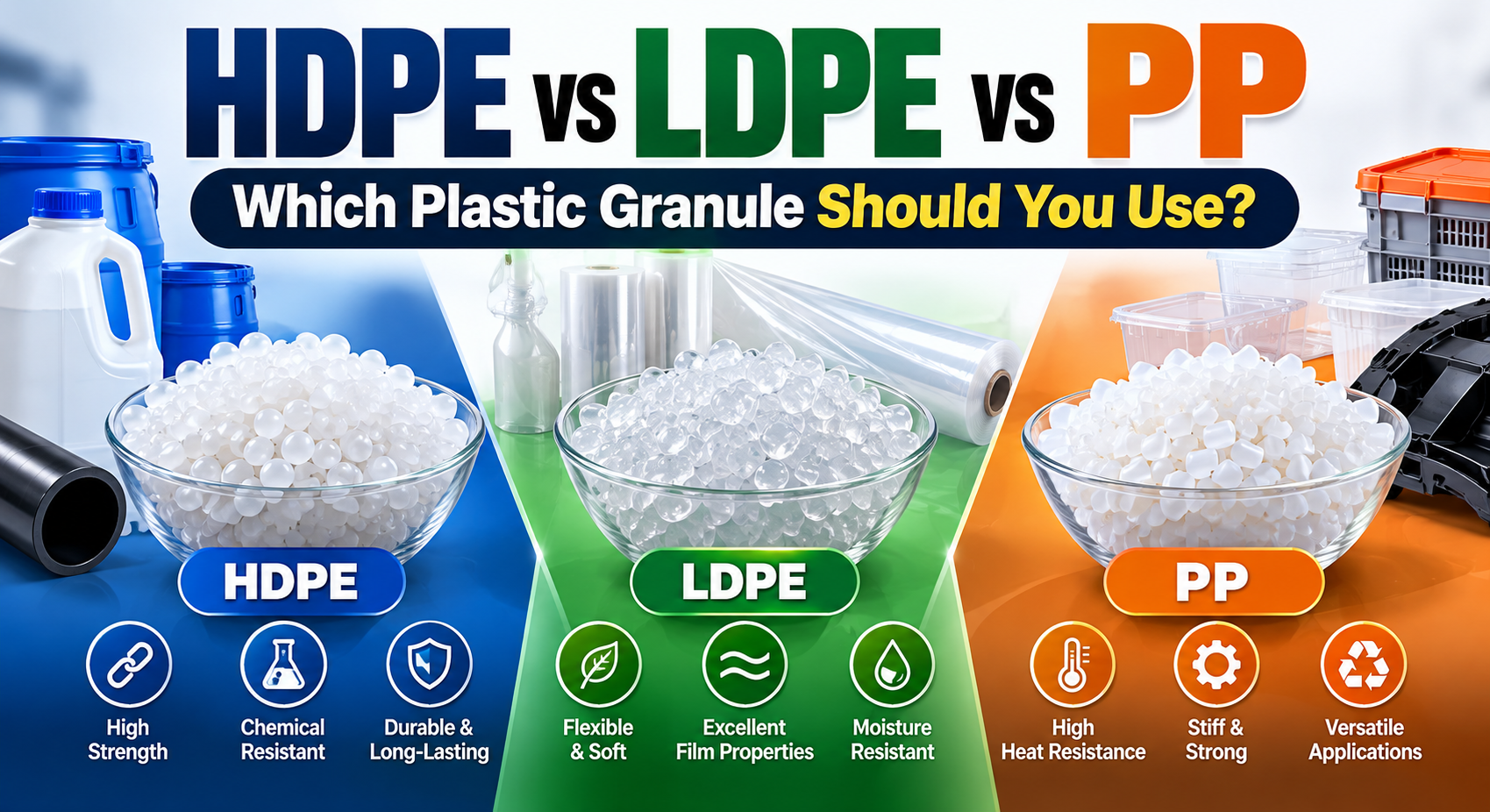
Choose PP for rigid, heat-tolerant parts. Choose HDPE for tough, chemical-resistant containers and pipes. Choose LDPE for soft, flexible film and liners. When two seem to fit, let temperature, flexibility and cost break the tie.
HDPE, LDPE and PP Granules Explained
Each material has a clear strength and a clear limit. Here is where each one fits.
HDPE Granules
HDPE is stiff, tough and resistant to many chemicals, moisture and impact, including at low temperatures. It is the usual choice for drums, crates, pipes, bottles and caps, carry bags and industrial containers.
Its limits are heat and clarity. It softens at lower temperatures than PP and is generally opaque, and it can warp as it cools if the part is poorly designed.
LDPE Granules
LDPE is soft, flexible and easy to process, with good moisture resistance and good sealing properties. It dominates packaging film, shrink wrap, bags, liners, squeeze bottles and wire and cable coating.
It is not a structural plastic. LDPE has lower stiffness, strength and heat resistance than HDPE or PP, so it is rarely used for rigid load-bearing parts.
PP Granules
PP is lightweight, rigid and heat tolerant, with good fatigue resistance. That makes it popular for injection-moulded household goods, automotive parts, appliance components, woven sacks, fibres, furniture and food containers. It also makes living hinges in caps and boxes.
Its main weakness is cold-temperature impact: standard PP can turn brittle in cold conditions unless it is a copolymer or impact grade. See our PPCP granules for impact-modified options.
HDPE vs LDPE vs PP: Quick Comparison
Typical values are indicative and vary by grade. Always check the data sheet for the exact material you plan to buy.
| Property | HDPE | LDPE | PP |
|---|---|---|---|
| Density (g/cm³) | About 0.94–0.97 | About 0.91–0.94 | About 0.90–0.91 |
| Stiffness | High | Low, flexible | High, rigid |
| Melting point | About 125–135°C | About 105–115°C | About 160–170°C |
| Impact in cold | Very good | Good | Fair; better in copolymers |
| Chemical resistance | Excellent | Good | Excellent |
| Typical use | Drums, crates, pipes, bottles | Film, bags, liners | Moulded parts, sacks, fibres |
Five Questions That Decide the Right Granule
Answer these before you ask any supplier for a quote.
Does the part need to be rigid or flexible?
Rigid, load-bearing parts point to PP or HDPE. Soft film, liners and squeezable products point to LDPE.
What temperature will it face?
Hot-fill, steam or dishwasher use favours PP because of its higher melting point. Freezer and outdoor winter use favours HDPE for toughness.
What process will you run?
Injection moulding, blow moulding, film extrusion and raffia tape each need a different melt flow. Match the Melt Flow Index to the process; our explainer on understanding Melt Flow Index (MFI) shows how.
Will it touch food, chemicals or sunlight?
Food contact, aggressive chemicals and UV exposure each limit the grades you can use. Confirm approvals and stabiliser content with the supplier.
What is your budget per kg?
Resin prices move with crude oil and demand, and recycled grades usually cost less than virgin. Check current benchmarks in our PP granules price per kg guide.
What to Verify Whichever Polymer You Choose
Choosing the right material is only half the job. The supplier must deliver it consistently.
Confirm the Polymer
Recycled lots can contain traces of other polymers. PE and PP contaminate each other and weaken parts, so ask how input scrap is sorted and tested.
Ask for Batch Test Data
Request MFI, moisture and ash data. Our guide to how to check PP granule quality lists the questions worth asking.
Understand the Process
Sorting, washing and extrusion decide final quality. Read how recycled PP granules are manufactured to know what a proper line looks like.
Run a Trial Lot
Mould or extrude a small batch before scaling up. Smaller trials also help with minimums; see PP granules MOQ for small manufacturers.
All Three Polymers Can Be Recycled
HDPE, LDPE and PP are all recyclable when sorted correctly, and recycled granules cut demand for virgin resin. Learn more in is PP recyclable and the benefits of recycled plastic granules. If you generate scrap yourself, see where to sell plastic scrap near me and how much plastic scrap is worth per pound.
Source PP Granules From a Local Manufacturer
Evonpolymers manufactures recycled PP granules at Bawana Industrial Area, New Delhi. Tell us your product, process and monthly volume, and we can suggest a suitable grade and share batch data. For regional pricing, read our recycled PP granules price in Delhi guide, to compare vendors see PP granules manufacturers in Delhi NCR, and for sustainability-led sourcing see eco-friendly plastic raw material suppliers in India.
Frequently Asked Questions
Q1What is the main difference between HDPE, LDPE and PP?
HDPE is dense, stiff and tough. LDPE is soft and flexible. PP is rigid and tolerates more heat than either. Their chain structures explain these differences.
Q2Which is stronger, HDPE or PP?
It depends on the measure. PP is generally stiffer and handles heat better, while HDPE has better impact strength, especially in the cold. Choose by the property your product needs most.
Q3Can I mix HDPE, LDPE and PP granules?
Not in general. The polymers do not blend well, and mixed lots usually give weak, brittle parts. Keep each polymer separate, from scrap bin to extruder.
Q4Which is cheapest?
Prices change with the market, grade and whether the granule is virgin or recycled. Compare quotes on the same grade and unit. For benchmarks, see our PP granules price in India guide.
Q5Is virgin or recycled better?
Virgin offers tighter consistency, and recycled offers lower cost and lower environmental impact. Many applications work well with recycled material, so see reprocessed vs virgin PP granules before you decide.
PP Granules vs HDPE Granules
Which material is better for your application.
GradesReprocessed vs Virgin PP Granules
Which feedstock is better for your use.
FundamentalsUnderstanding Melt Flow Index (MFI)
Why MFI is the key spec to match to your process.
PricingPP Granules Price Per Kg
A 2026 rate guide for buyers in India.
SustainabilityIs PP Recyclable?
A complete guide to recycling polypropylene granules.
QualityHow to Check PP Granule Quality
What to ask for before accepting any quote.
Not Sure Which Granule Fits Your Product?
Share your product, process and volume. Our team will help you choose the right grade and quote it.