
Benefits of Recycled Plastic Granules: A 2026 Guide for Manufacturers
Recycled plastic granules used to be treated as the fallback option — something you reached for only when the budget wouldn't stretch to virgin resin. That thinking has largely reversed. With plastic waste volumes rising, Extended Producer Responsibility (EPR) norms tightening across India, and processing technology maturing, recycled granules are now a first-choice input for a growing share of moulders and manufacturers — not just a cost workaround.
This guide covers the real, practical benefits of recycled plastic granules — environmental, economic, and performance-related — and where they genuinely outperform virgin resin, so you can decide where they fit in your own production line.
The Case for Recycled Granules Is No Longer Just About Cost
Three forces are pushing recycled plastic granules into the mainstream of Indian manufacturing at the same time: regulation, resin price volatility, and buyer demand for lower-impact products. Together they've turned what was once a niche, price-driven choice into a strategic sourcing decision.
Under India's Plastic Waste Management (Amendment) Rules and the EPR framework administered by the CPCB, producers, importers, and brand owners are required to meet defined targets for using recycled plastic content in their packaging and products. That alone has turned recycled granules from an optional cost-saver into a compliance requirement for a large part of the packaging and consumer-goods industry.
In Short
Recycled PP and other recycled thermoplastic granules cut virgin resin dependence, lower per-kg input cost, divert plastic waste from landfill and informal burning, and — when properly sorted, washed, and batch-tested — deliver mechanical performance close enough to virgin resin for the large majority of moulded applications.
What Recycling Actually Prevents
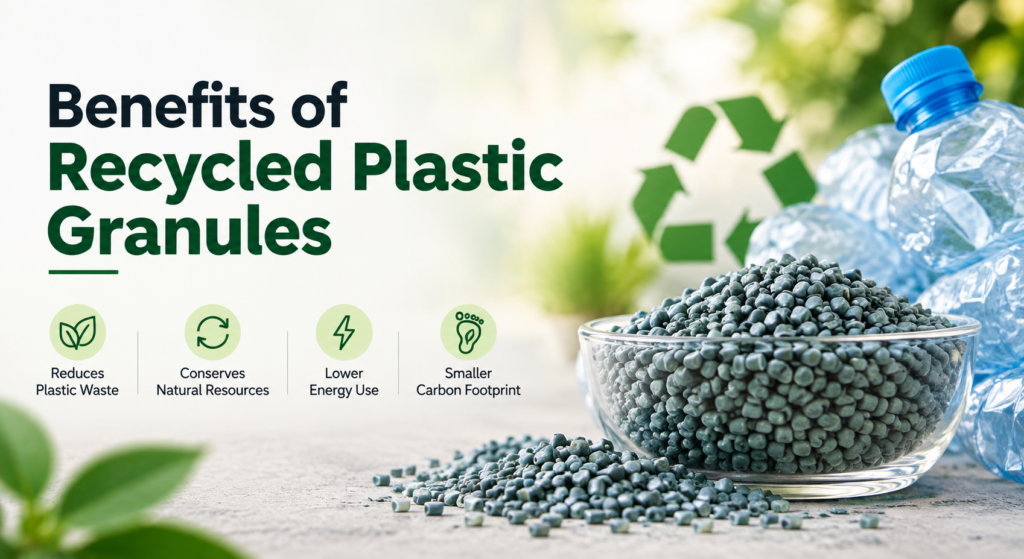
The environmental case for recycled granules isn't abstract — it maps to four concrete outcomes in the plastic value chain.
Diverts Waste From Landfill & Informal Burning
Every kilogram of post-industrial or post-consumer scrap that's reprocessed into granules is a kilogram that doesn't end up in a landfill, a waterway, or an open-burning pile — the last of which is still a significant source of urban air pollution in parts of North India.
Lowers Energy Use Versus Virgin Production
Converting sorted plastic scrap into granules is a mechanical process — shredding, washing, melting, and pelletising. It skips the upstream steps of extracting and refining crude oil or natural gas into resin, which is the most energy- and emissions-intensive stage of making virgin plastic.
Reduces Demand on Virgin Feedstock
Every tonne of recycled granule produced is a tonne of naphtha or propylene that doesn't need to be drawn from the petrochemical chain, which helps insulate downstream buyers from the price swings that come with crude oil volatility.
Supports a Circular Material Loop
Recycled granules let manufacturing scrap and end-of-life plastic re-enter the production cycle instead of being a one-way input. For brand owners, this also supports the recycled-content and circularity claims increasingly expected by retailers and regulators alike.
How This Plays Out in Practice
A manufacturer that runs injection-moulding rejects and runners back through a recycler isn't just cutting waste disposal costs — they're closing the loop on their own material stream. The same logic applies at a larger scale in clusters like Bawana, where scrap collected from packaging, textile, and automotive units across Delhi-NCR is sorted, washed, and reprocessed into granules that go straight back into local manufacturing. Understanding how recycled PP granules are manufactured makes it easier to see exactly where in that chain the environmental savings come from.
Where the Cost Savings Actually Come From
Recycled granules are cheaper than virgin resin, but the reasons why matter — because they also explain where the savings can disappear if you buy carelessly.
Recycled PP granules typically price well below virgin PP, because the feedstock is waste rather than freshly refined petrochemical resin, and because reprocessing skips the capital-intensive polymerisation stage entirely. For a full breakdown of where recycled and virgin material sit on cost, see virgin vs recycled PP granules, and for current market rates, our PP granules price in India and recycled PP granules price in Delhi guides both track this by grade.
The savings aren't just about the sticker price, either. Recycled granules tend to be less exposed to the sharp swings that hit virgin resin when crude oil prices move, since their pricing is anchored to local scrap availability and processing cost rather than the global petrochemical chain. That makes budgeting and quoting noticeably more predictable for manufacturers running on recycled input.
The Catch
Cost savings hold up only when the material performs. An untested, poorly sorted batch that causes rejects, downtime, or inconsistent parts can erase the per-kg saving many times over. This is why batch testing and supplier vetting matter more for recycled material than for standardised virgin grades.
Recycled Doesn't Have to Mean a Compromise
The performance gap between recycled and virgin PP has narrowed considerably as sorting, washing, and compounding techniques have improved. Here's what a well-processed recycled granule can actually deliver.
Comparable mechanical strength for most applications
For crates, dunnage, furniture components, and non-critical automotive parts, batch-tested recycled PP routinely matches the tensile and impact performance that the application actually needs — the gap only widens at the very top end of precision moulding.
Consistent melt flow when the source stream is controlled
Melt Flow Index (MFI) consistency — the single biggest processability variable — comes down almost entirely to how tightly the scrap stream and reprocessing batches are controlled, not to whether the resin is virgin or recycled.
Customisable through fillers and additives
Talc-loaded and filler-grade recycled compounds let manufacturers dial in stiffness, cost, or weight for a specific part, the same way compounders do with virgin resin.
Verifiable, not just assumed
A supplier that shares MFI, ash content, moisture, and tensile data per batch removes the guesswork. Our guide on how to check PP granule quality walks through exactly what to ask for before you commit to an order.
Where Recycled Granules Deliver the Most Value
Recycled PP isn't a universal replacement for virgin resin — but for the majority of moulded and extruded applications, it's a genuinely strong fit.
Recycled Granules Are a Strong Fit When
The part doesn't demand food-contact certification or pharma-grade purity, and cost predictability matters.
Virgin Resin Still Makes Sense When
Regulatory, medical, or extremely tight-tolerance requirements leave no room for batch-to-batch variation.
Where Recycled Plastic Granules Are Already Working Well
Across India's manufacturing base, recycled granules have moved from a fringe input to a mainstream one in these categories.
Storage crates & industrial containers
Furniture & household moulded goods
Woven sacks & flexible packaging
Toys & general consumer items
Pipe fittings & non-critical automotive parts
Chairs & moulded seating
Recycled Granules, Backed by Batch Data
Evonpolymers reprocesses PP scrap into granules from its facility in the Bawana Industrial Area, Delhi, with every batch — regardless of order size — tested for Melt Flow Index, ash and moisture content, tensile and impact strength, and colour matching. That's what turns "recycled" from a cost label into a reliable, specifiable input.
The full range — Colored, Black, Milky, Natural, Filler, PPCP, and BOPP granules — is available at competitive rates, and the toll recycling program can convert your own plastic scrap into spec-matched granules, closing the loop on your own production waste.
Frequently Asked Questions
Q1 What are the main benefits of recycled plastic granules?
The core benefits are lower material cost than virgin resin, reduced plastic waste going to landfill or open burning, lower energy use compared to producing virgin resin from scratch, less exposure to crude-oil-driven price swings, and — when properly sorted and tested — mechanical performance suitable for most moulded applications.
Q2 Are recycled plastic granules as strong as virgin plastic?
For the majority of applications — crates, furniture, packaging, non-critical automotive and industrial parts — properly reprocessed and batch-tested recycled PP performs close enough to virgin resin that the difference isn't the limiting factor. The gap only becomes significant for ultra-precise or food/medical-grade applications with strict virgin-content requirements.
Q3 Why are recycled granules cheaper than virgin resin?
Recycled granules skip the capital- and energy-intensive step of refining crude oil or natural gas into virgin resin. Their feedstock is waste plastic rather than freshly produced petrochemical material, which keeps the per-kg cost lower and generally more stable against oil-price swings.
Q4 Do recycled granules help with EPR compliance in India?
Yes. Under India's Plastic Waste Management Rules and the EPR framework, producers, importers, and brand owners are required to meet minimum recycled-content targets for certain plastic categories. Sourcing verified recycled granules is one of the more direct ways manufacturers meet that obligation.
Q5 How do I make sure the recycled granules I buy are good quality?
Ask for the MFI range, request a batch test report covering ash, moisture, and tensile data, confirm the scrap source, and run a small trial batch through your own process before committing to a recurring order. Our guide on how to check PP granule quality covers this in detail.
More From Evonpolymers Insights
Explore related guides on grades, pricing, and sourcing — or browse the full library on our Insights page.
Virgin vs Recycled PP Granules
How the two feedstocks compare on cost, consistency, and use case.
PricingPP Granules Price in India
A nationwide view of what shapes PP granule pricing.
PricingRecycled PP Granules Price in Delhi
Current Bawana-cluster rates by grade, and what drives the spread.
ProcessHow Recycled PP Granules Are Manufactured
The sorting, washing, and reprocessing steps behind every batch.
QualityHow to Check PP Granule Quality
What to ask for before you accept any supplier's quote.
SourcingPP Granules MOQ for Small Manufacturers
How order size affects both minimum quantities and per-kg rates.
SourcingPP Granules Manufacturers in Delhi NCR
How to shortlist a reliable vendor in the Delhi-NCR cluster.
FundamentalsUnderstanding Melt Flow Index (MFI)
Why MFI is the single most important spec to match to your process.
Source Recycled PP Granules You Can Actually Rely On
Ask Evonpolymers for a current per-kg quote matched to your grade, colour, and order volume — with batch test data included, not sold separately.