
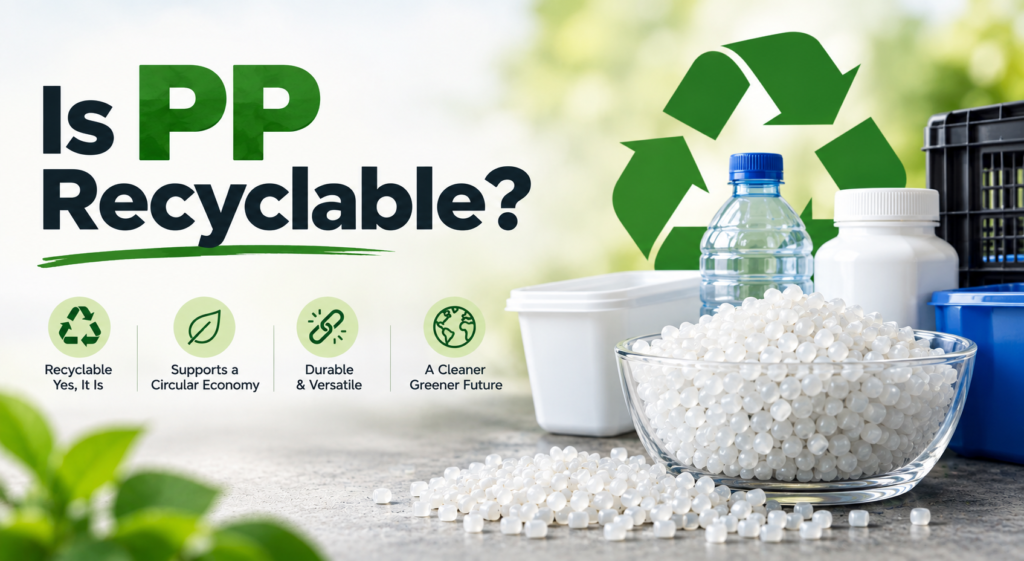
Is PP Recyclable? A Complete Guide to Recycling Polypropylene Granules
Short answer: yes, polypropylene is recyclable — it carries resin identification code #5 and is one of the more widely reprocessed commodity plastics in India. The longer answer is more useful, because "recyclable" and "actually gets recycled" are two different questions, and the gap between them is where most of the confusion about PP sits.
This guide covers what makes PP recyclable at a material level, how the mechanical recycling process actually works, how many times a batch can realistically go through the cycle before quality drops, and where recycled PP granules end up once they're made.
Yes — PP Is Recyclable, With Code #5
Polypropylene is a thermoplastic, which is the property that makes it recyclable in the first place: thermoplastics soften and melt when heated and re-solidify on cooling, so they can be shredded, melted, and re-pelletised without the polymer breaking down into something unusable — unlike thermoset plastics, which cure into a permanent chemical structure and cannot be re-melted at all.
Look for the "5" inside the triangular chasing-arrows symbol on a PP product — that's the Society of the Plastics Industry resin code that identifies it for sorting facilities. It's the same system used for PET (#1), HDPE (#2), PVC (#3), LDPE (#4), and PS (#6).
In Short
PP is mechanically recyclable, meaning it's shredded, washed, and melted back into granules rather than broken down chemically. It's one of the easier commodity plastics to reprocess, which is why recycled PP granules are widely available — but real-world recycling rates still depend heavily on collection and sorting infrastructure, not just the material's chemistry.
How PP Actually Goes From Scrap to Granule
Mechanical recycling is the dominant route for PP, and it happens in four broad stages before the material is ready to be moulded again.
Collection & Sorting
Scrap is gathered from industrial sources — moulding runners, rejects, and off-cuts — or from post-consumer streams like packaging and containers, then sorted by resin type and colour, since PP mixed with other plastics degrades the output quality.
Shredding & Washing
Sorted scrap is shredded into flakes, then washed to remove labels, adhesives, dirt, and any residual product contamination — this step has the single biggest effect on how clean and consistent the final granule turns out.
Melting & Extrusion
Clean, dried flakes are melted and pushed through an extruder, which homogenises the material and lets any needed additives — stabilisers, fillers, colourants — be blended in at this stage.
Pelletising & Testing
The extruded strand is cooled and cut into granules, which a quality-conscious processor will then test for Melt Flow Index (MFI), ash content, and moisture before the batch ships out.
For a closer look at each of these steps and how they scale in an industrial setting, see how recycled PP granules are manufactured.
PP Can Be Recycled — But Not Infinitely
Every time PP is melted and re-extruded, its polymer chains shorten slightly through thermal and mechanical stress, which gradually lowers molecular weight and impact strength and raises melt flow. Mechanically recycled PP is generally good for somewhere around 2 to 5 reprocessing cycles before mechanical properties degrade enough to matter for demanding applications — though for less critical parts, well-stabilised material can go further. This is exactly why batch testing, not just a "recycled" label, is what determines whether a given granule is fit for your application.
Recyclable in Theory vs. Recyclable in Practice
PP as a polymer is easy to recycle. Whether a specific batch of scrap actually becomes a usable granule depends on a handful of practical factors.
Contamination level
Food residue, labels, other resins, and metal fragments all reduce yield and quality. Clean, single-resin industrial scrap recycles far more reliably than mixed post-consumer waste.
Colour and additive mix
Black and dark-coloured scrap is easier to recycle profitably because colour masking hides minor inconsistencies; natural or light-coloured scrap needs a cleaner, more carefully sorted stream to stay usable.
Number of prior reprocessing cycles
First-pass industrial scrap (runners, rejects) recycles closer to virgin-equivalent performance than material that's already been through several recycling loops.
Access to sorting and collection infrastructure
PP's recyclability on paper only converts into recycled material at scale where collection, sorting, and reprocessing capacity actually exist — which is why industrial clusters with dense recycling infrastructure process a disproportionate share of the country's PP scrap.
India's Recycling Infrastructure for PP
India generates a large and growing volume of plastic waste each year, and PP — used heavily in packaging, woven sacks, automotive components, and household goods — makes up a significant share of it. Dense industrial clusters such as Bawana in Delhi have grown around exactly this supply, with recyclers competing on sorting quality and batch consistency as much as on price.
India's Plastic Waste Management Rules and the associated Extended Producer Responsibility (EPR) framework have also pushed recycled-content targets onto producers and brand owners, which has increased structured demand for verified recycled PP rather than informally reprocessed material.
Where the Rates Sit
Recycled PP pricing varies by grade, colour, and testing rigour. For current market ranges, see our PP granules price in India and recycled PP granules price in Delhi guides.
What "Recyclable" Does and Doesn't Guarantee
PP's recyclability is a real, material-level fact — but it doesn't automatically mean every batch performs like virgin resin.
Recycled PP Performs Reliably When
The scrap source is controlled and the output is tested rather than assumed.
Recycled PP Needs Extra Scrutiny When
The scrap history and processing quality aren't disclosed by the supplier.
Common Applications for Recycled PP Granules
Once reprocessed and tested, recycled PP granules re-enter manufacturing across a wide range of moulded and extruded products.
Storage crates & industrial containers
Furniture & household moulded goods
Woven sacks & flexible packaging
Toys & general consumer items
Pipe fittings & non-critical automotive parts
Chairs & moulded seating
Recycled PP, Tested at Every Batch — Not Just Labelled Recyclable
Evonpolymers reprocesses PP scrap into granules from its facility in the Bawana Industrial Area, Delhi. Every batch — regardless of order size — is tested for Melt Flow Index, ash and moisture content, tensile and impact strength, and colour matching, so "recyclable" turns into a granule you can actually specify against.
The full range — Colored, Black, Milky, Natural, Filler, PPCP, and BOPP granules — is available at competitive rates, and the toll recycling program can turn your own PP scrap into spec-matched granules, closing the loop on your own production waste.
Frequently Asked Questions
Q1 Is PP plastic recyclable?
Yes. Polypropylene carries resin identification code #5 and is a thermoplastic, meaning it can be melted and re-formed without the polymer breaking down chemically. It's one of the more commonly mechanically recycled commodity plastics.
Q2 How many times can PP be recycled?
Mechanically recycled PP typically holds up well for around 2 to 5 reprocessing cycles before shortened polymer chains noticeably reduce impact strength and raise melt flow. Well-stabilised material used in less demanding applications can sometimes go further; batch testing is the only reliable way to confirm where a given lot stands.
Q3 Does recycled PP perform as well as virgin PP?
For most applications — crates, furniture, packaging, non-critical automotive and industrial parts — properly sorted, washed, and batch-tested recycled PP performs close enough to virgin resin that the difference isn't the limiting factor. See our comparison in virgin vs recycled PP granules for where the gap does and doesn't matter.
Q4 Why doesn't all PP actually get recycled, if it's recyclable?
Recyclability is a property of the material; actual recycling rates depend on collection systems, sorting infrastructure, and contamination levels. Mixed, dirty, or uncollected PP scrap simply never reaches a recycler, regardless of how technically recyclable the polymer itself is.
Q5 How can I check if a batch of recycled PP granules is good quality?
Ask for the MFI range, request a batch test report covering ash, moisture, and tensile data, confirm the scrap source, and run a trial batch through your own process before committing to a recurring order. Our guide on how to check PP granule quality covers this in detail.
More From Evonpolymers Insights
Explore related guides on grades, pricing, and sourcing — or browse the full library on our Insights page.
How Recycled PP Granules Are Manufactured
The sorting, washing, and reprocessing steps behind every batch.
GradesVirgin vs Recycled PP Granules
How the two feedstocks compare on cost, consistency, and use case.
SustainabilityBenefits of Recycled Plastic Granules
The environmental, economic, and performance case for switching.
PricingPP Granules Price in India
A nationwide view of what shapes PP granule pricing.
PricingRecycled PP Granules Price in Delhi
Current Bawana-cluster rates by grade, and what drives the spread.
QualityHow to Check PP Granule Quality
What to ask for before you accept any supplier's quote.
SourcingPP Granules MOQ for Small Manufacturers
How order size affects both minimum quantities and per-kg rates.
SourcingPP Granules Manufacturers in Delhi NCR
How to shortlist a reliable vendor in the Delhi-NCR cluster.
FundamentalsUnderstanding Melt Flow Index (MFI)
Why MFI is the single most important spec to match to your process.
Source Recycled PP Granules Backed by Batch Data
Ask Evonpolymers for a current per-kg quote matched to your grade, colour, and order volume — with batch test data included, not sold separately.