
Black vs Natural vs Colored vs Milky PP Granules: Which to Buy?
Ask three moulders which PP granule colour to buy and you will get three answers, because the right choice depends on what you make, how it will be used and what finish your customer expects. Pick wrong and you pay for it in rejected parts, colour mismatch or a higher cost per piece.
This guide compares black, natural, colored and milky polypropylene granules on appearance, cost, performance and typical applications, so you can match the grade to your product before you place an order.
What Do the Four PP Granule Colours Actually Mean?
Polypropylene in its raw state is a translucent, off-white polymer. The colour categories you see in the market describe what happens after that: whether the material is left as it is, whitened, tinted or made fully dark. Colour comes from pigments or masterbatch, and with recycled granules it also reflects how well the input scrap was sorted before reprocessing.
That matters for more than looks. Pigment loading, base resin quality and input scrap all influence flow, strength and surface finish. If you are still deciding between feedstocks, start with our guides on reprocessed vs virgin PP granules and virgin vs recycled PP granules, then come back to choose the colour.
In Short
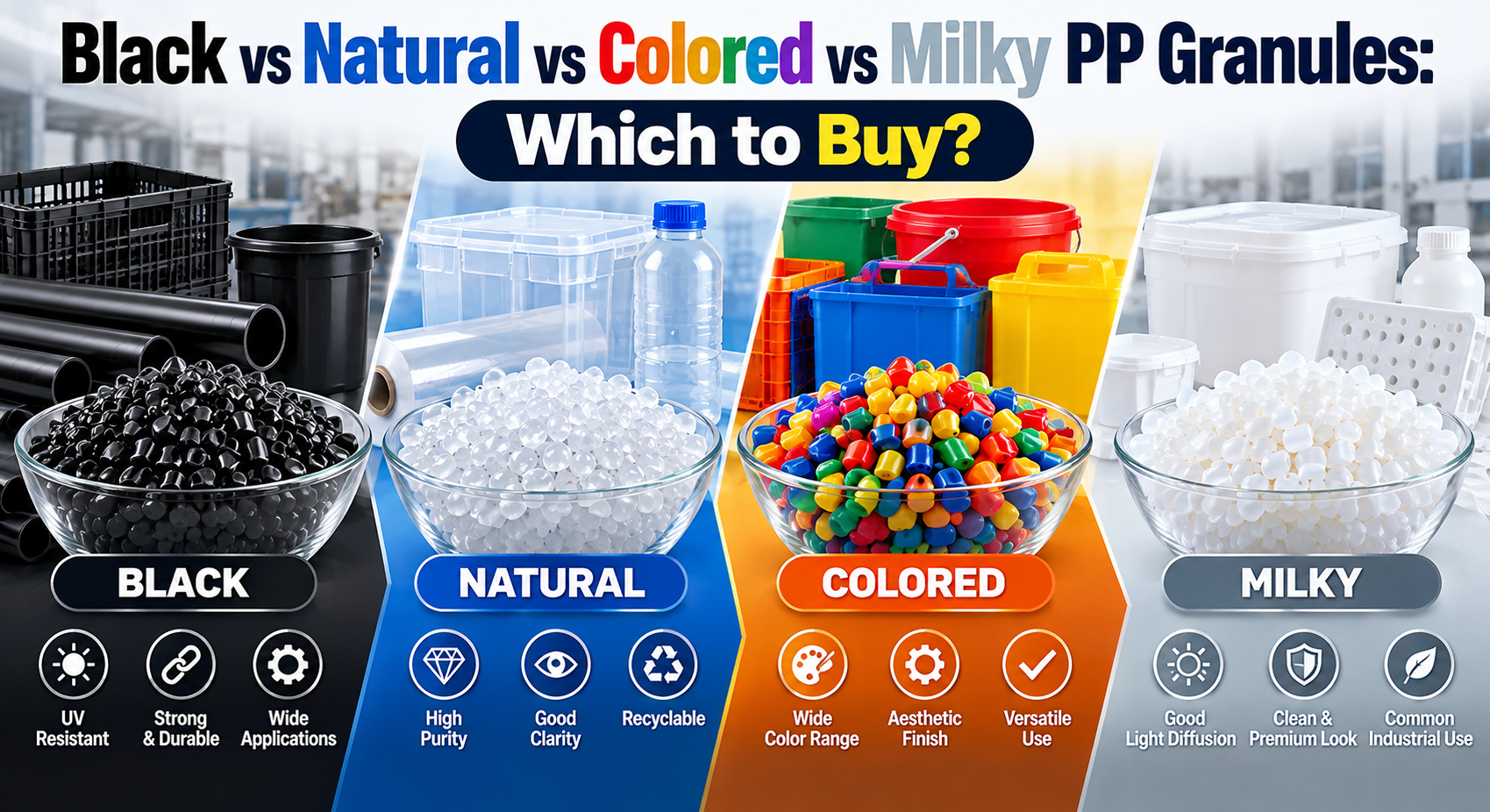
Natural gives you the cleanest base and the most colour freedom. Milky suits opaque, light-toned parts. Colored saves a masterbatch step when the shade is fixed. Black is the most forgiving grade and is common for hidden, industrial and outdoor parts.
Black, Natural, Colored and Milky PP Granules Compared
Each grade solves a different problem. Here is where each one fits and where it falls short.
Black PP Granules
Black is the most widely used colour in recycled PP because dark pigment hides the colour variation that comes from mixed input scrap. It is common in crates, pipes and conduits, automotive and appliance parts, garden products and industrial components. Carbon black also gives useful protection against UV exposure, which helps outdoor products.
The trade-off is flexibility: black cannot be turned into a lighter shade later, and it is unsuitable where food contact or a bright finish is needed. See our black PP granules.
Natural PP Granules
Natural granules carry no added colour, so they are the most versatile base. Moulders can add their own masterbatch to hit an exact shade, and the translucent material works well for products where a clean, light look matters, such as containers, caps and household items.
Because nothing masks defects, natural grade needs cleaner input and tighter quality control, and it usually costs more than darker grades. See our natural PP granules.
Colored PP Granules
Colored granules arrive pre-pigmented, so you skip dosing masterbatch at the machine. That reduces mixing errors and gives repeat batches a consistent shade, which suits buckets, furniture, toys, stationery and consumer products where the colour is fixed.
The limit is that you are locked to the shade you buy, and recycled colored grades can show slight variation between lots. Always approve a sample first. See our colored PP granules.
Milky PP Granules
Milky granules are opaque and white to cream in tone. They hide what is inside better than natural grade and give a soft, even look, which makes them popular for containers, appliance housings, caps, closures and moulded household articles. They also take light pigment well when you want pastel shades.
They are less forgiving than black if the input is dirty, and heavy exposure to sunlight can eventually yellow lighter material unless it is stabilised. See our milky PP granules.
Quick Comparison Table
Use this as a starting point. Final suitability depends on your resin grade, process and customer specification.
| Grade | Appearance | Best For | Watch Out For |
|---|---|---|---|
| Black | Solid, deep black; hides defects and speckles | Crates, pipes, automotive, industrial and outdoor parts | Cannot be lightened; not for food-contact or bright products |
| Natural | Translucent, off-white; no added pigment | Custom-coloured products, clean-look containers and caps | Shows contamination; needs clean input and often costs more |
| Colored | Pre-pigmented in a fixed shade | Buckets, furniture, toys, consumer goods | Shade locked in; confirm lot-to-lot consistency |
| Milky | Opaque white to cream | Housings, closures, household and appliance parts | May yellow with long sun exposure unless stabilised |
Five Questions That Decide the Right Grade
Work through these before you ask for quotes. They narrow the field faster than comparing prices alone.
Is the colour fixed or customer-specified?
If your customer needs an exact shade, natural grade plus masterbatch gives control. If the shade is the same every time, pre-coloured granules save a process step.
Will the part be seen or hidden?
Visible consumer products need a clean surface and even colour. Hidden or industrial parts can use black and save money.
Will it live outdoors?
Sunlight degrades unprotected polymer. Black grades benefit from carbon black, while lighter colours should be UV-stabilised if they will face long exposure.
What flow and strength does your process need?
Colour does not replace the Melt Flow Index. Match MFI to your moulding or extrusion method first. Our explainer on understanding Melt Flow Index (MFI) shows how.
What is your budget per kg?
Darker grades usually cost less because they tolerate mixed input. Lighter grades need cleaner sorting, which raises the price. Check current benchmarks in our PP granules price per kg guide.
What to Verify Whatever Colour You Buy
A good price on the wrong material is still a bad buy. Whichever grade you choose, test before you commit.
Ask for Batch Test Data
Request MFI, moisture and ash data for each batch. Our guide to how to check PP granule quality lists the questions worth asking.
Inspect the Granules
Look for uniform size and shape, even colour, and no dust, black specks or unmelted flakes. Uneven granules often point to weak sorting or a poorly controlled line.
Run a Trial Lot
Mould a small batch and check shrinkage, surface finish and colour match before scaling up. Smaller trials also help if you are working to a low minimum; see PP granules MOQ for small manufacturers.
Understand the Process
Sorting, washing and extrusion decide final quality. Read how recycled PP granules are manufactured to know what a proper line looks like.
Colour Choice Is Also a Sustainability Choice
Recycled black and coloured granules give mixed scrap a second life and cut demand for virgin resin. If you are new to the topic, read is PP recyclable and the benefits of recycled plastic granules. Buyers building greener supply chains can also see our list of eco-friendly plastic raw material suppliers in India.
Buy the Right Grade From a Local Manufacturer
Evonpolymers supplies black, natural, colored and milky PP granules from Bawana Industrial Area, New Delhi. Tell us your product, resin grade and monthly volume, and we can suggest a suitable colour and share batch data. For regional pricing, read our recycled PP granules price in Delhi guide, and to compare vendors, see PP granules manufacturers in Delhi NCR.
Frequently Asked Questions
Q1Which PP granule colour is cheapest?
Black is usually the most economical because dark pigment masks colour variation in the input scrap. Natural and milky grades need cleaner sorting, so they generally cost more. Exact rates change with the market; see our PP granules price in India guide.
Q2Can I colour natural PP granules myself?
Yes. Natural granules are the standard base for in-house colouring. You add masterbatch at the machine to reach the shade you want, which gives the most control but needs accurate dosing.
Q3What is the difference between natural and milky PP granules?
Natural PP is translucent and carries no added colour. Milky PP is opaque and white to cream, so it hides contents and gives a softer, more uniform look.
Q4Are black PP granules weaker than other colours?
Not by default. Strength depends mainly on the base resin, MFI and processing quality rather than colour. Black is simply more tolerant of mixed input, so confirm quality with batch test data.
Q5Is PP the right material for my product, or should I consider HDPE?
It depends on stiffness, impact and temperature needs. Our comparison of PP granules vs HDPE granules helps you decide before you pick a colour.
Reprocessed vs Virgin PP Granules
Which feedstock is better for your application.
MaterialPP Granules vs HDPE Granules
Choosing the right polymer for your product.
PricingPP Granules Price Per Kg
A 2026 rate guide for buyers in India.
QualityHow to Check PP Granule Quality
What to ask for before accepting any quote.
FundamentalsUnderstanding Melt Flow Index (MFI)
Why MFI is the key spec to match to your process.
SustainabilityBenefits of Recycled Plastic Granules
A 2026 guide for manufacturers.
Not Sure Which Colour to Buy?
Share your product, process and volume. Our team will help you pick the right PP granule grade and quote it.