
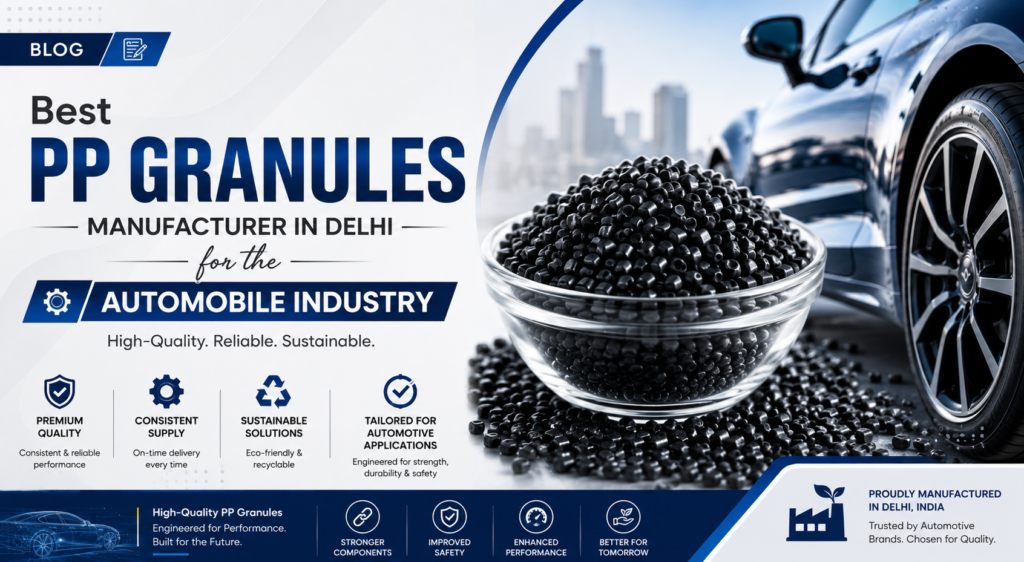
Best PP Granules Manufacturer in Delhi for the Automobile Industry
If you mould plastic components for cars, two-wheelers or commercial vehicles anywhere in the Delhi NCR belt, the polypropylene granule supplier you choose affects your rejection rate more than almost any other single purchasing decision. Polypropylene is the single most-used plastic in a modern vehicle, and Delhi is home to one of India's densest clusters of PP granule manufacturers feeding that demand directly. Here's what to know before you commit to bulk volumes.
Why the Automobile Industry Runs on Polypropylene
A typical midsize passenger car uses more than a thousand individually shaped polymer parts, and three plastics — polypropylene, polyethylene and polyurethane — account for over half of that total plastic content. PP alone shows up in bumper fascias, dashboards, door panels, interior trims, HVAC ducting, wheel-arch liners and, increasingly, battery-pack enclosures in electric vehicles. For a component maker, that means PP granule quality isn't a background purchasing decision — melt flow variance between batches shows up directly as short-shots and flash on the press, and colour drift shows up as mismatched trims on the assembly line.
Sourcing for a different industry?
Evonpolymers' full PP granule range also serves rigid packaging, molded furniture, home appliances and household-goods manufacturing alongside automotive components.
Why Polypropylene Specifically — Not Just Any Plastic
PP isn't the default automotive resin by accident. It combines a set of properties that few alternatives match at bulk manufacturing scale.
- Low density keeps vehicle weight down, improving fuel or battery efficiency
- Impact-grade PPCP deforms on a low-speed hit and largely recovers its shape afterward
- Resists engine-bay heat, road salt, fuels and most cleaning chemicals without degrading
- Moulds cleanly into complex dashboard, duct and trim geometry without secondary tooling
- Costs less per kilogram than ABS or PC while processing faster on the line
- Reprocesses cleanly, letting scrap and rejects be converted back into usable granules
Why Delhi NCR Is India's Automotive Component Hub
Delhi NCR — spanning Delhi itself along with Gurugram, Manesar, Faridabad, Noida and Ghaziabad — is one of the densest automotive manufacturing corridors in the country. The belt hosts Maruti Suzuki's extensive supplier network alongside major component groups like UNO Minda, JBM Group, Lumax Industries and Samvardhana Motherson, plus hundreds of smaller Tier-2/3 moulders producing trims, HVAC parts and lighting housings. Within Delhi itself, Bawana Industrial Area in the city's north-west has become one of the densest concentrations of PP granule and plastic dana manufacturers in North India, while Mayapuri remains a long-established hub for automobile spares and recycling.
That density is genuinely useful for a buyer — shorter supply lines mean less transit damage to moisture-sensitive granules and faster reorder cycles that support JIT-style production. But it also means quality varies significantly between manufacturers, since not every unit in the cluster runs formal batch testing. That's exactly why the checklist later in this guide matters more here than in a less concentrated market.
PP Granule Grades Automotive Manufacturers Actually Use
A properly organised Delhi-based manufacturer should stock multiple PP grades to serve different parts of the vehicle.
| Grade | Typical Automotive Use | Product Page |
|---|---|---|
| PPCP Granules | Bumpers, fenders, energy-absorbing impact parts | View → |
| Black PP Granules | Dashboards, under-body panels, ducting, structural trims | View → |
| Colored PP Granules | Interior trims, cabin components, colour-matched clips & brackets | View → |
| Natural PP Granules | Hidden structural parts, base resin for custom pigmentation | View → |
| Filler PP Granules | Talc/CaCO₃-stiffened door panels & structural brackets | View → |
| Milky PP Granules | Concealed interior components, spacers, clips | View → |
| BOPP Granules | Protective wrapping film for packaged components in transit | View → |
If you're unsure which grade fits a specific part, Evonpolymers' team can match melt flow index and colour requirements to your mould before you commit to bulk volumes.
Checks That Matter Even More for Automotive Parts
Because automotive components are load-bearing, safety-adjacent, or highly visible in the cabin, verifying these four data points before a bulk order matters more than it does for general consumer goods.
Melt Flow Index Reports
Mismatched MFI is a leading cause of short-shots and flash on automotive tooling — always ask for documented batch reports, not a single data sheet.
Ash & Moisture Content
A direct indicator of how clean the source scrap and reprocessing were — critical for parts that need a consistent surface finish.
Tensile & Impact Results
Non-negotiable for load-bearing or energy-absorbing parts like bumpers, brackets and structural trims.
Batch-to-Batch Consistency
Especially important for visible cabin trims and clips, where shade variation across a production run is the most common assembly-line complaint.
What Organised Manufacturers Handle Differently
Plastic processing units operating formally in Delhi's industrial estates work under Delhi Pollution Control Committee (DPCC) consent-to-operate norms and route effluent through proper treatment infrastructure — a meaningful difference from unregistered scrap-processing operations. For automotive component makers this matters doubly: OEMs are increasingly pushing sustainability and traceability requirements down the supply chain, with several global automakers already integrating recycled polypropylene into production parts such as bumper components. Buying from a manufacturer with documented compliance, in-house testing, and a formal toll recycling process isn't just a quality safeguard — it increasingly supports your own paperwork when an OEM audits your material supply chain.
How to Choose a Reliable PP Supplier for Automotive Parts
Run through this checklist before finalising any bulk supplier in Delhi NCR.
Verifiable facility address
A real manufacturing plot you can visit, not an unregistered trading setup.
In-house batch testing
MFI, ash content, tensile & impact strength — documented on every batch, not one-time samples.
Capacity to match your draw
Enough monthly output headroom to support your volumes through peak season.
Custom MFI & colour formulation
Ability to tune melt flow and shade to your specific mould and process.
Toll recycling support
Converts your own scrap, runners and rejects back into usable granules.
Track record
Years of consistent operation, rather than a recently set-up intermediary.
The Advantage of Sourcing Locally From Delhi
If your press shop is anywhere in Delhi, Gurugram, Faridabad, Noida or the wider NCR belt, sourcing from a Delhi-based manufacturer directly cuts down on the following.
Freight cost and transit time compared with interstate sourcing
Reorder friction — short-haul delivery supports tighter, JIT-compatible cycles
Vendor risk — a facility you can physically audit before bulk commitment
This is one of the most underrated reasons NCR-based component makers keep sourcing locally even when marginally cheaper material is available elsewhere.
Automotive-Grade Consistency, Built In Delhi
Evonpolymers operates from J 270, Sector 2, Bawana Industrial Area, New Delhi – 110039, at the centre of the NCR's plastics manufacturing belt. With 19+ years of industry experience, a monthly production capacity of 250+ MT and a pan-India supply network, the operation is built for component makers who need consistency across repeat bulk orders — not just a one-time competitive quote.
Every batch is verified through an in-house testing lab covering Melt Flow Index, ash & moisture content, tensile & impact strength, and colour matching. The automotive-relevant range spans PPCP for impact parts, Black PP for dashboards and trims, Colored and Natural PP for interior components, and Filler PP for stiffened structural parts — with a toll recycling program available for manufacturers looking to convert their own production scrap back into usable granules.
Frequently Asked Questions
Q1Is recycled PP strong enough for automotive components?
For non-critical trims, clips, brackets and interior panels, well-processed recycled PP with verified MFI, ash content and impact strength performs on par with virgin resin. For safety-critical or structural parts, most manufacturers still specify virgin or a controlled virgin-recycled blend, tested batch by batch.
Q2What's the difference between PP homopolymer and PPCP for auto parts?
Homopolymer PP is stiffer and more economical, suited to parts that don't face heavy impact loads. PPCP (PP copolymer) has rubber phases built into the resin, giving it much better low-temperature impact resistance — the reason it's the default for bumpers, fenders and other energy-absorbing parts.
Q3What lead time and minimum order quantity should I expect?
This varies by manufacturer, grade and season. Bulk industrial suppliers typically work in multi-tonne lots, with lead times set by current production scheduling — always confirm current MOQ, lead time and freight terms directly with the supplier before finalising a purchase order.
Q4Can granule colour be matched to an existing mould or part?
Yes — most organised PP manufacturers offer custom colour matching by tuning masterbatch dosage against a physical sample or shade code, then verifying consistency across batches in an in-house lab before dispatch.
Q5Does Evonpolymers offer toll recycling for a manufacturer's own plastic scrap?
Yes. Evonpolymers runs a toll recycling program that converts a customer's own PP scrap, runners, rejects and production waste back into usable granules to the customer's specification, in addition to its standard PP granule range.
Looking for an Automotive-Grade PP Supplier in Delhi?
Contact Evonpolymers for a bulk quote tailored to your grade, colour and volume requirements.